The Best Crops to Start in July for Fall Greenhouse Harvests
While most Canadian gardeners are winding down by late August, scanning the sky for frost warnings and pulling out spent tomato vines, greenhouse growers are just getting started. July is not an ending. For anyone growing under glass, it is the month when smart planning separates those who simply garden from those who grow food with intention.
At Florian Sunrooms, we build high-end greenhouses in Canada designed to take on every season, including the ones most gardeners have already written off. This guide walks you through the best crops to start in July, how to manage them through summer heat, and how to set yourself up for a fall harvest worth celebrating.
Inside This Guide
- Which crops to start in July for a strong fall greenhouse harvest
- How to choose the right varieties and read maturity dates accurately
- Seed starting techniques that work during summer heat
- How to manage common summer planting challenges inside a greenhouse
- Succession planting strategies to keep harvests coming all season long
- How a quality greenhouse structure extends your productive growing window
Why July Is the Secret Sweet Spot for Fall Planting
Most gardening advice focuses on spring. But there is an equally important calendar running in reverse, and July is where it starts. To plan a fall harvest, you work backward from your first expected frost date. Across much of Canada, that falls somewhere between late September and mid-October. Gardeners can use Canada’s official Plant Hardiness Zone Map from Natural Resources Canada to better estimate frost timing and seasonal growing windows based on their specific region.
Count back the days to maturity for your chosen crops, add two weeks for germination and establishment, and you arrive squarely in July.
Inside a greenhouse, those calculations shift further in your favour. A well-built structure buffers temperature swings, captures residual heat into the evening, and protects young seedlings from the erratic late-summer storms that can wipe out an outdoor planting overnight. Our climate is generous in its warmth but unpredictable in its timing, and a greenhouse lets you respond to that unpredictability on your own terms.
Planning and Timing for Fall Planting: How to Read the Calendar Like a Pro
The core principle is simple: find your average first frost date, subtract the crop's days to maturity, then add a 14-day buffer to account for slowed growth in cooling temperatures. That final date is your ideal seed-starting window. For most of Canada, July 1 to July 20 is the target range. Regional planting charts from West Coast Seeds are especially helpful for comparing timing differences between provinces and adjusting greenhouse schedules accordingly.
Seeds started after July 20 may not reach maturity before conditions deteriorate, though inside a greenhouse the window stretches noticeably longer.
Florian Sunrooms offers custom greenhouse solutions built to hold heat efficiently and allow for precise environmental management, giving you more flexibility on both ends of that calendar.
The Best Crops to Start in July for Your Fall Greenhouse Harvest
The crops that thrive in fall greenhouses are cool-season varieties that prefer lower temperatures for their best growth. Many taste better after a light frost, which concentrates their sugars and deepens their flavour. West Coast Seeds’ fall and winter gardening guide also notes that many cool-season crops develop improved texture and sweetness as temperatures begin cooling in autumn.
Leafy Greens
Kale, spinach, arugula, Swiss chard, and lettuce are the backbone of any fall greenhouse planting. They germinate quickly, produce harvests within 30 to 60 days, and tolerate cool temperatures with ease. Kale in particular becomes sweeter after frost exposure, making late-October harvests genuinely superior to summer ones.
Radishes and Turnips
These root vegetables mature in as few as 25 to 30 days, making them ideal for succession planting. Start a tray in early July, another in mid-July, and a third in early August for continuous harvests from September through late fall.
Asian Greens
Bok choy, tatsoi, mizuna, and komatsuna grow quickly, handle cool temperatures well, and add variety to a fall harvest. Most reach maturity within 40 to 50 days and respond well to cut-and-come-again harvesting.
Broccoli and Cauliflower
These brassicas need 60 to 80 days, which makes a July start essential. They thrive in the cooling temperatures of September and October and are far more productive in a greenhouse than outdoors, where inconsistent temperatures cause premature bolting or poor head formation.
Carrots and Beets
Root vegetables planted in July reach harvest size by October and store well in cool conditions. Choose shorter, faster-maturing varieties such as Chantenay carrots or early beet hybrids for the best results in a fall greenhouse.
Herbs
Cilantro, parsley, and dill prefer cooler growing conditions and will reward a July start with harvests well past the point where outdoor plantings have given up.
Choosing Appropriate Varieties and Maturity Dates: The Details That Make the Difference
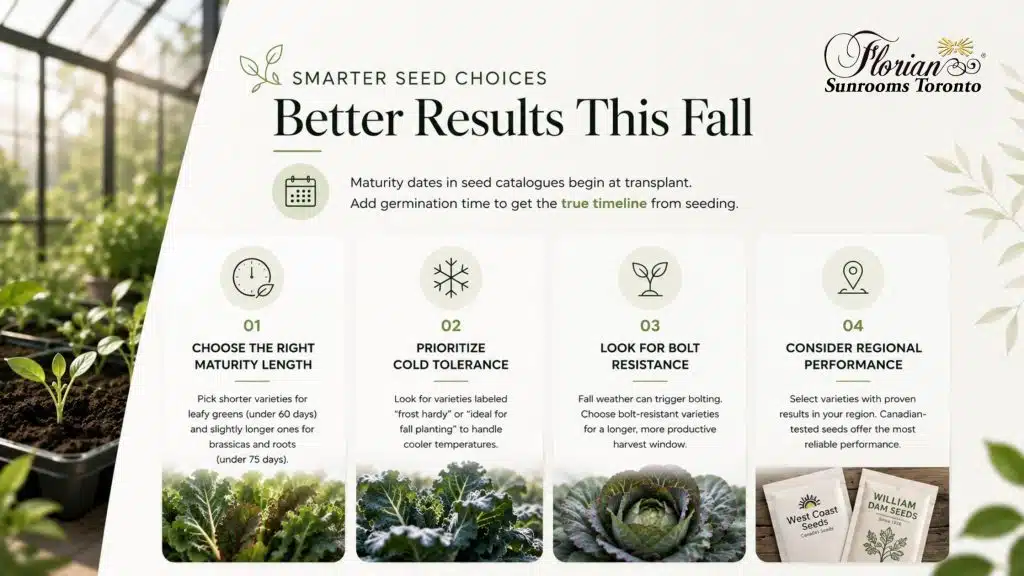
Days to maturity in seed catalogues count from transplant, not from seeding. Factor in germination separately: a crop listed at 60 days may take 70 or more from the moment you sow. When selecting varieties for fall greenhouse planting, prioritise:
- Short to medium maturity: Under 60 days for leafy crops, under 75 for brassicas and roots
- Cold tolerance: Look for descriptors like "frost hardy" or "suitable for fall planting"
- Bolt resistance: Fluctuating fall temperatures make bolt-resistant varieties worth seeking out
- Regional performance: Seed companies like West Coast Seeds and William Dam Seeds offer Canadian-tested varieties with reliable data
Seed Starting Techniques for Summer: Working With the Heat, Not Against It
Starting cool-season crops in summer heat requires a few deliberate adjustments. A 30 to 40 percent shade cloth over seedling trays during peak afternoon hours reduces soil temperature significantly. Check moisture twice daily and keep seed-starting mix evenly damp, never waterlogged. Sow in the early evening to take advantage of cooler overnight temperatures for initial germination.
Florian Sunrooms designs greenhouses with ventilation systems and operable windows that are especially valuable in summer, when managing airflow matters as much as managing heat retention in winter. Their four-season solarium additions are built to handle exactly these seasonal demands.
Managing Summer Planting Challenges: Heat, Pests, and the Unexpected
Greenhouse temperatures can climb quickly on sunny July days. Keep roof vents and side windows open during peak hours and aim to hold temperatures below 32 degrees Celsius around seedlings. A thermostat-controlled fan makes this automatic.
Aphids, spider mites, and fungus gnats are more active in warm conditions. Inspect seedlings daily, maintain good airflow, and use yellow sticky traps as an early warning system. Ontario’s greenhouse integrated pest management guidelines recommend early monitoring, strong airflow, and preventative controls as some of the most effective ways to reduce greenhouse pest pressure naturally.
Beneficial insects like ladybugs are highly effective in enclosed growing spaces. For watering, a drip irrigation system or simple timer removes the guesswork and keeps moisture consistent on the hottest days.
A well-insulated, properly ventilated structure like those offered by Florian Sunrooms, recognised for luxury conservatories for year-round natural light, gives you the environmental control that a basic polytunnel simply cannot provide.
Greenhouse Management and Succession Planting: The Strategy Behind Continuous Harvests
A single July planting gives you a single harvest window. Succession planting changes that. Rather than seeding an entire tray of spinach at once, seed a portion every 10 to 14 days. As the first planting reaches harvest size, the second is growing strongly and the third is just germinating. The result is a steady supply rather than a single glut followed by nothing.
Keep a simple tracking calendar noting what was seeded, when, and where. The Canadian Food Inspection Agency also highlights the importance of consistent greenhouse sanitation, airflow management, and crop monitoring as part of long-term greenhouse growing success.
Use multiple trays to stagger plantings without disturbing established crops, and develop a harvest-and-reseed rhythm so cleared space is never wasted. Crops that respond to cut-and-come-again harvesting extend this window further still.
Proper skylight installations and roof glazing in a Florian greenhouse maximise natural light at lower fall sun angles, which matters more with each passing week as days shorten.
We offer professional home renovation services that include complete greenhouse builds tailored to the Canadian climate.
Utilizing Planting Calendars and Resources: The Tools That Sharpen Your Timing
Precise timing depends on your location. A July planting window that works in the Fraser Valley may need adjustment for southern Ontario or the Atlantic provinces. Key resources for Canadian greenhouse growers include Agriculture and Agri-Food Canada's Plant Hardiness Zone Maps, provincial extension programs, and the West Coast Seeds planting chart, which includes greenhouse-specific guidance used widely across Canada.
A quality greenhouse also changes your effective growing zone. Many growers find that a well-built four-season structure adds the equivalent of one to two hardiness zones to their capacity, opening up crop options that would not survive outdoors. Florian Sunrooms designs premium backyard greenhouses in Canada built specifically for long-term durability, environmental control, and year-round growing in challenging Canadian climates.
Key Takeaways
- July is the ideal month to start fall greenhouse crops, working backward from your first expected frost date
- The best crops include leafy greens, brassicas, root vegetables, Asian greens, and cool-season herbs
- Choose short-maturity, cold-tolerant, bolt-resistant varieties suited to Canadian conditions
- Manage summer heat, consistent moisture, and pest pressure as your primary July challenges
- Succession planting every 10 to 14 days produces a continuous harvest through fall
- A premium, well-insulated greenhouse dramatically extends your effective growing season
Frequently Asked Questions
What vegetables can I start in July for a fall greenhouse harvest?
July is ideal for kale, spinach, lettuce, arugula, bok choy, radishes, turnips, broccoli, cauliflower, carrots, beets, cilantro, parsley, and dill. These cool-season crops mature within 30 to 80 days and perform best in the lower temperatures of fall. Fast-growing varieties are especially useful for maximizing shorter Canadian growing windows.
How does a greenhouse extend my growing season in Canada?
A greenhouse captures heat, buffers temperature drops, and protects crops from frost. In most Canadian climates, a quality structure can extend your growing season in Canada by 8 to 12 weeks on either end, allowing earlier spring planting and harvests well into late fall or winter. Proper insulation and ventilation play a major role in maintaining stable growing conditions throughout the season.
Is succession planting inside a greenhouse difficult for beginners?
It is straightforward with a basic tracking system. Start by seeding one crop in thirds, spaced two weeks apart. The key is consistency and clear records of what you planted and when. Even beginner greenhouse growers can quickly build a reliable harvest routine using this method.
What is the biggest mistake people make with fall greenhouse crops?
Starting too late. Many gardeners wait until August or September, leaving insufficient time for crops to reach maturity. Starting in July gives everything the full window it needs. Waiting too long also reduces the amount of daylight available for strong plant development later in the season.
Do I need a special greenhouse structure for year-round growing in Canada?
Yes. A basic polytunnel lacks the insulation and structural integrity for Canadian year-round growing. A purpose-built greenhouse with proper glazing, ventilation, and a frame engineered for snow loads is the better long-term investment. Stronger materials and better environmental control also help reduce long-term maintenance and temperature fluctuations.
Build the Growing Structure That Works as Hard as You Do
Gardening in Canada demands resilience. The window for outdoor growing is always narrower than you wish, and the weather has its own agenda. A greenhouse changes the equation entirely, giving you control, consistency, and a harvest season that stretches well beyond anything an outdoor bed can offer.
The crops you start in July will be on your table in October, when the outdoor beds are bare and the first frost has come and gone. That is not luck. That is planning, paired with the right structure.
Florian Sunrooms designs and builds premium greenhouse and sunroom structures for Canadian homeowners who want more from their outdoor space. Ready to grow beyond the season? Contact Florian Sunrooms today to explore what a custom greenhouse can do for you.